

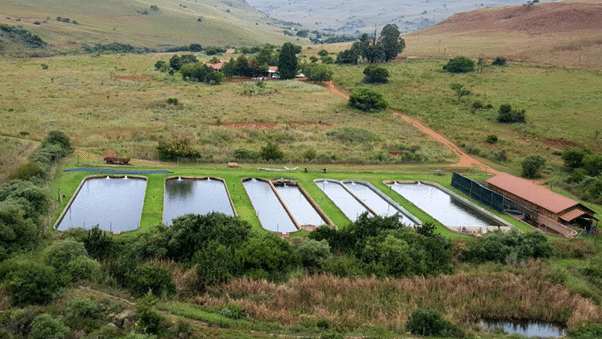
A South African trout farm – an attempt by the Department of Environmental Affairs, Forestry and Fisheries to declare trout invasive would have imperiled the viability of such hatcheries. FOSAF’s court victory has, for the moment, stymied government’s intention but the Department has appealed the judgment.
Ed Herbst writes: What became known as the ‘Trout Wars’ is well documented in a folder of that name on this website.
The Trout Wars had their origin in 1980 when the provincial environmental authority in the Western Cape, the Cape Department of Nature and Environmental Conservation, decided to stop breeding trout at its Jonkershoek hatchery in Stellenbosch.
It was entirely justified in taking this decision for two reasons, one financial the other ideological.
CDNEC felt that breeding trout for the recreational enjoyment of what was seen as a moneyed elite should be a private enterprise initiative.
The second reason could also be justified. It was felt that taxes should be spent on conserving indigenous species, particularly those which were threatened with extinction.
What CDNEC was not justified in doing was portraying trout as the singular threat to endangered minnows to support its decision to stop breeding trout at Jonkershoek
In so doing it ignored the fact that the biggest threat to these minnows is environmental degradation (caused a range of factors including, pollution due to sewage and solid waste, industrial and agricultural chemicals and products, poor farming methods, water abstraction, etc.) a threat which it was having little success in containing and which to date continues to be the major issue affecting the vast majority of catchments in SA.
There is no evidence that trout have exterminated any minnow species in South Africa and the reason is not difficult to discern – until they reach about a kilogram, trout diet is insectivorous and trout in South African’s streams rivers rarely reach that size.
Study after study, here and in Kenya, reveal that minnow do not feature in the stomach contents of trout in running water.
As a result of the decision by CDNEC the federation of South African Fly Fisher – FOSAF – was formed on 1 March 1986.
It is a lobby group which seeks to protect the interests of fly anglers and to conserve the habitat in which they fish.
On 10 September 2021 FOSAF won its case against the Department of Environmental Affairs and was awarded costs.
FOSAF had gone to court challenging the Minster’s failure to provide sufficient information about why trout were to be declared invasive in SA.
FOSAF had in 2014 agreed the Phakisa principles with the Department which in essence meant that where trout occur in SA they would not be listed as invasive and would be managed through a more self-regulatory system for hatcheries and the trout value chain which will enhance employment rather than decrease it.
Trout are alien, not invasive because in a hot and arid country plagued by continual drought, trout are confined to a tiny, high-altitude fraction of the country where the environmental conditions exist in which it can survive.
In essence, the judge found that the consultation process had been flawed and this impacts on all environmental legislation already promulgated within this context.
Informed consultation is the cornerstone of government interaction with its citizens. This case was about a failure to provide sufficient information and the opportunity for meaningful feedback.
Not unexpectedly, the Minister of Forestry, Fisheries & Environment has filed a Notice of Appeal against the judgement in favour of FOSAF which was handed down in the North Gauteng High Court on 10 September.
As indicated on its website, FOSAF will oppose the appeal but at the same time will continue to negotiate in good faith with government in this regard.
Google ‘An Assessment of the Social and Economic Impacts of Tourism Development in Dullstroom, Mpumalanga’ and you will be taken to a study by Dr Gareth Butler which shows that the majority of people in this country town a three-hour drive from Johannesburg, are financially dependent in some way or another on local trout hatcheries and have been empowered by the fly angling-related tourism income that they enable.
This is important in a country where almost 12 million people out of a total population of 55 million are unemployed.
An important contribution to this debate was made in an interview with an expert on the status of endangered South African minnows, Dr Jeremy Shelton which was carried in The Mission magazine.
Shelton speaks of the co-existence between trout and minnows and suggests that, on balance, the presence of trout is advantageous to the country.
Proof of this came with the discovery of a hitherto unknown redfin minnow, Pseudobarbus skeltoni, in the Krom tributary of the Smalblaar River in the Du Toit’s Kloof valley near the town of Worcester in the Western Cape. If trout had not exterminated this minnow, after a century, then what justification could there be in suggesting that it is an ecological threat? Indeed, the very presence of trout is proof of the environmental integrity of the water systems where they are found because their existence is dependent on pure water with a high oxygen content.
The major piscine threat to our endangered mountain stream minnows comes from smallmouth bass which prey on them and it is disingenuous of the DEA to use the alleged threat by trout to endangered minnow species to declare them as invasive.
In email correspondence with me, Dr Adam Daniel, the Fisheries Manager at Fish and Game New Zealand, said that his department would intervene if trout became a threat to an endangered indigenous species - but this had not proved necessary.
In Australia, the government uses money derived from the sale of angling licences to run its hatcheries on the basis of 80% indigenous fish and 20% trout. It strongly promotes all forms of recreational angling and considers its trout breeding and stocking program to be an integral element of that approach.
In South Africa, one is supposed to purchase a freshwater fishing licence from the post office but, to an increasing extent the postal system has become dysfunctional. Being asked to produce one’s fishing licence is unheard of so there is little incentive to buy one when there is no indication that the money so derived is used to promote recreational angling.