

A C Harrison, the founder of the Cape Piscatorial Society in its present form, kept examples of the most common Western Cape mayflies in aquariums and he found that many if not most species emerged on humid nights which ensured that their wings did not dry out. This also made them less vulnerable to predation. Many caddis species emerge at night and lay their eggs when light levels are low.
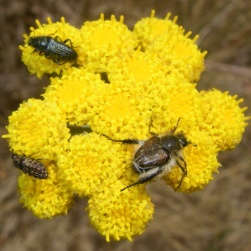
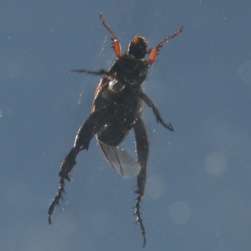
At the same time terrestrial insects, in particular ants and beetles, contribute more to trout diet over a season than mayfly and caddis.
Ants are always present throughout the year from dawn to dusk and beetles are present in substantial numbers in early spring.
Furthermore, unlike emerging aquatic insects, which have high escape potential, beetles, ants and hoppers are very vulnerable to capture once they land in the water. For this reason, trout which are selectively locked onto a hatch of aquatic insects will often turn aside to take an ant or beetle because they have become a form of prey that cannot escape.
While terrestrial patterns are usually seen in the context of floating flies, they can be even more deadly when fished as a nymph with strike indicator such as Rio’s new two-tone mono incorporated in a greased leader.
- Tying Ed Herbst's Hopper - Ed Herbst (link to The Spirit of Fly Fishing)
- Thoughts on contemporary hopper design - Ed Herbst (link to The Spirit of Fly Fishing)
- Why fish hoppers in Autumn? Of hoppers and toebiters - Ed Herbst (link to The Spirit of Fly Fishing)
- Persistence pays off on the Smalblaar - Philip Hills
- The Wolf Spider - Leonard Flemming
- Leonard’s Wolf Spider - Peter Brigg
- Fred Steynberg’s Spider - Ed Herbst
- The Yarn Spider - Keith Wallington
- Small Stream Terrestrials - Ed Herbst
- Which Terrestrial - Ed Herbst
- Sunken Terrestrials - Ed Herbst (Chapter 13, South African Fishing Flies An Anthology of Milestone Patterns)
- Development of the Wolf Spider - Peter Brigg (Chapter 11, South African Fishing Flies An Anthology of Milestone Patterns)
- Mario's Inchworms - Mario Geldenhuys (Chapter 12, South African Fishing Flies An Anthology of Milestone Patterns)
- A Beetle Story - Dr Hans van Zyl (Chapter 23, South African Fishing Flies An Anthology of Milestone Patterns)
- A recently introduced sawfly, Nematus Oligospilus Förster (Hymenoptera: Tenthredinidae), that defoliates willows in southern Africa – A.J. Urban & C.D. Eardley
- Courtesy of The Mission you can download Ed's Hopper - Step-by-step Fly Tying as a PDF or you can view the article on The Mission website.